Comments Off on Aproximaciones feministas a la discapacidad: Relaciones de poder, emociones y posicionamiento hacia el campo [Feminist approaches to disability: power relations, emotions and positioning towards the field]
Points of interest:
The article presents a feminist approach to the field of disability, addressed from a methodological perspective.
It introduces reflective work around experience.
Grounded theory is used from a feminist paradigm and the disability perspective.
The findings in the fieldwork focus on emotions and reflexivity through the use of a logbook.
From a feminist perspective, it is hoped to produce conscious and challenging knowledge of the places of enunciation of the actors and actresses.
Notes:
The following summary was prepared by the Millennium Nucleus DISCA and is based exclusively on the publication. Therefore, it cannot be used for citations or references.
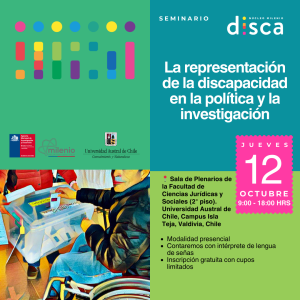
We will address the issue of disability representation in policy and research. There will also be presentations of research on disability in various topics.
The event will take place on October 12, 2023 at the Universidad Austral de Chile, Campus Isla Teja, Valdivia, Chile, in face-to-face mode.
Disability representation is a vital tool for introducing, addressing and challenging ideas about disability. We recognize that, despite its potential to inform and change perceptions, representation can also reinforce inequalities and perpetuate existing stereotypes. For this reason, an in-depth scholarly analysis of how people with disabilities and disability as a phenomenon are and can be represented is crucial.
We will seek to generate a rigorous and diverse academic dialogue about disability in general and the issue of disability representation in policy and academic research. In addition, we seek to generate a meeting space for people who do research on disability.
The seminar will have two parts: during the morning, it will be an open space where research on disability from different disciplines will be presented. During the afternoon, the particular topic of disability representation will be addressed through two discussion tables, one on political representation and the other on representation in research.
The seminar will be held at the Universidad Austral de Chile, Campus Isla Teja, Valdivia, Chile, on October 12, 2023 from 9:00 to 18:00 hrs. The Seminar will be interpreted in Chilean Sign Language (LSCh) and for attendance, prior registration is required at this link.
Program
09:00 to 09:30 Welcome
09:30 to 11:00 Present your research in 10 minutes
Room 1 and 2 simultaneous
09:30 to 11:00 Present your research in 10 minutes (Room 2)
Nelson Muñoz, University of Chile. Therapeutic itineraries of the rehabilitation process of children with disabilities and their families users of the Western Metropolitan Health Service of Santiago.
Pamela Gutiérrez, University of Chile. Inclusion of people with disabilities and the concept of human rights in Chilean health policies.
Pía Rodríguez-Garrido, University of O’Higgins. Obstetric and gynecological violence and its impact on the mental health of Chilean women with disabilities.
Andrea Tereucán, Universidad de los Lagos. Experiences of health and care in childhood and adolescence of the Autism Spectrum in Osorno, a territorial view (1990-2023).
Karina Pinto, University of Chile. Political Affections, Illness and Disability: Problematizing the biomedical model of rehabilitation from a feminist anti-empowerment perspective.
Soledad Toro and Wanda Espejo, Una ruta sin Barreras. The right to recreational sports and tourism: personal assistance as a human right.
Space for questions
09:30 to 11:00 Present your research in 10 minutes (Room 1)
Esteban Burgos, University of Concepción. The challenge of political inclusion in Chile: Barriers and Facilitators that affect the Electoral Participation of People with Disabilities.
María Paz Santos Ricartes. Economic growth of people with disabilities.
Daniella Leal, Pontificia Universidad Católica de Chile. People with Disabilities and their Participation in the Labor Market: Evidence from ENDIDE 2022.
Andrea Montecinos, Juan González and Constanza Corvalán. Pontificia Universidad Católica de Valparaíso. The new legal status in relation to the entry to school of children with disabilities.
Bárbara Suazo, University of Chile. The political from the common in organizations of the disability field: The case of Colectivo Autismo Chile between 2011 and 2019.
Francisca Higuera, Shirlia Jara, Ana Lizama, Daniela Sepúlveda and Ninosca Bravo. Catholic University of Temuco. Dissonances of inclusion with Francisca Our companion and friend.
Space for questions
11:00 to 11:30 Coffee break
11:30 to 13:00 Present your research in 10 minutes
Daniela Jaure, AVANZA Inclusion. Intellectual disability, social inclusion and quality of life. A look from those who are protagonists.
Ninosca Bravo, Catholic University of Temuco. Social representations of special education pedagogy students about intellectual disability and developmental disabilities.
Edison Calahorrano, Central University. The relational approach as a methodology for the representation of people with disabilities in scientific research.
Mauricio López, DISCA Nucleus. The power of Experts by Experience: Co-creation of knowledge in disability research.
Constanza López, University of Valparaíso. Care as a possible foundation for the production of knowledge: an approach from feminist disability studies.
Jame Rebolledo, University of Chile. Research with disability activists from Feminist Epistemologies.
Space for questions
13:00 to 14:00 Lunch (included in the Seminar)
14:00 – 15:30 Panel 1: Political Representation of Disabilities
Diana Vallejo, U. Iberoamericana Mexico City. The disca as a symbol of the transvaluation of the disabled.
Diego Solsona, U. de los Lagos. Manufactured by the State, intervened from the biopower: the case of people with disabilities in Chile.
Jaime Ramírez, U. of Chile. Analyzing the development of social mobilization of people with disabilities in Chile 15 years after the convention.
Florencia Herrera, U. Diego Portales. ‘Look at me!’: Public and digital political campaigns of people with disabilities in the socio-political crisis in Chile.
15:30 to 15:45 Coffee break
15:45 to 17:15 Panel 2: Representation of Disability in Scientific Research
Luis Vera, U. of Chile. Paola Arroyo, U. Alberto Hurtado. José Reyes, U. Academia de Humanismo Cristiano: “Disabled” teaching experiences. Reflections situated from the bodies.
Vanessa Vega and Félix González-Carrasco, Pontificia Universidad Católica de Chile. Izaskun Álvarez, U. de las Américas. Inclusive research as an engine for the transformation of practices in intellectual disability.
Valquiria Ramos, Pontificia Universidad Católica de Chile. Decision-making processes in academic journals on disability.
Carlos Araneda-Urrutia, Pontificia Universidad Católica de Chile. Where are and how do academics with disabilities inhabit the university: Contributions for a methodological discussion about the affective infrastructures of academic capacitism.
In the Millennium Nucleus DISCA we are looking for a student in practice in the area of Communications for the position of Student in Practice of Communications, who must have an interest in disability and inclusion issues and stand out for their creativity and autonomy in the work.
Its main task will be to collaborate with the Communications Coordination to position the Nucleus as a reference in the national discussion related to disability and citizenship, producing and disseminating content on the knowledge generated to other areas of society.
In addition, he/she will have to support in media management, produce activities, keep records of the Nucleus’ actions, among other actions related to his/her work.
Those interested in applying must meet the following requirements:
University student in the area of Communications.
Experience in editing, production and creation of audiovisual material.
Good writing and spelling skills.
Proactivity, creativity and autonomy at work.
Ability to work in multidisciplinary and diverse teams.
To apply, the following documents must be submitted:
Link to portfolio with your audiovisual material (video / photography).
Letter of presentation and motivation where you express why you are interested.
The deadline for applications is Friday, September 29, 2023 and must be sent via email to comunicaciones@nucleodisca.cl.
Selected individuals will be invited to an online interview at the end of September.
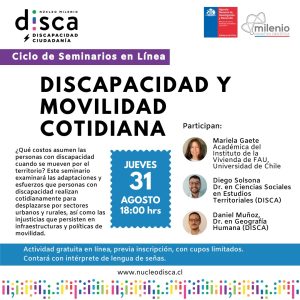
The seminar will address the ways in which disability is understood by our transportation and planning systems.
Three researchers will examine the adaptations and efforts that people with disabilities make on a daily basis to move around urban and rural areas, as well as the injustices that persist in national mobility infrastructures and policies.
In response to the question “What costs do people with disabilities assume when moving around the territory?”, the DISCA Millennium Nucleus has invited three researchers to investigate experiences, organizations, policies and research on the daily mobility of people with disabilities.
We will be joined by Mariela Gaete Reyes, an academic from the Housing Institute of the Faculty of Architecture and Urbanism of the University of Chile. She is dedicated to research on accessibility and disability and to teaching in the Architecture program, in the Master in Residential Habitat and in the Doctorate in Territory, Space and Society, a program in which she is part of the academic committee.
The sociologist Diego Solsona, Master in Social Research and Development from the Universidad de Concepción and Doctor of Social Sciences in Territorial Studies from the Universidad de los Lagos, will also present. He works as a postdoctoral researcher in the Anillos project “Territorial Inequalities”. He is also a collaborating professor in the anthropology program at the Universidad de Los Lagos. His main lines of research are: spatial mobilities, citizen participation and social imaginaries in people with disabilities.
In addition, DISCA researcher Daniel Muñoz, PhD in Human Geography (University of Edinburgh), Master in Urban Development (PUC) will present his work. He is a postdoctoral researcher at the Housing Institute of the University of Chile. His research focuses on everyday mobility practices of people with disabilities, with attention to care and interdependence. Methodologically, Daniel specializes in ethnography and ethnomethodological video analysis.
If you would like to attend, register at this link.
The book brings together contributions from thirteen authors who present conceptual reflections, descriptions of practices, and methodological insights that are useful for understanding embodiments and mobilities. From this perspective, multiple sensory, affective, material, and infrastructural factors gain renewed importance, offering more complex—and at the same time more concrete—descriptions of everyday ways of moving.
Given the diversity of its content, this is a crossroads of analytical approaches that gradually trace cartographies of what embodiments and mobilities contribute to the relational understanding of multiple areas of social life. This understanding can lead to pathways for urban transformation aimed at creating more livable, inclusive, and just territories for their inhabitants.
On June 28, Brandeis University held the webinar “Parents and Parenting with Disabilities: Perspectives from Chile” with three Chilean researchers, including Florencia Herrera, Director of DISCA and PhD in Social and Cultural Anthropology from the University of Barcelona.
Jimena Luna, Industrial Civil Engineer and Project Coordinator at CEDETi UC, and Soledad Véliz, Doctorate in Education from the Pontificia Universidad Católica de Chile and researcher at CEDETi UC, participated in the dialogue.
To learn more about their perspectives on parenting and raising children with disabilities in Chile, as well as their experiences and research, you can review their webinar here.
The DISCA Millennium Nucleus is pleased to invite the academic community to submit their proposals for presentations for our next seminar entitled “The Representation of Disability in Policy and Research”. The event will take place on October 12, 2023 at the Universidad Austral de Chile, Campus Isla Teja, Valdivia, Chile, in face-to-face mode.
We seek to generate an academic, rigorous and diverse dialogue about disability in general and the issue of disability representation in policy and academic research. In addition, we seek to generate a meeting space for people who research on disability.
The seminar will have two parts: the first will address the particular issue of disability representation in policy and research. The second part will be open to the presentation of research on disability in various topics related to the work of Núcleo DISCA.
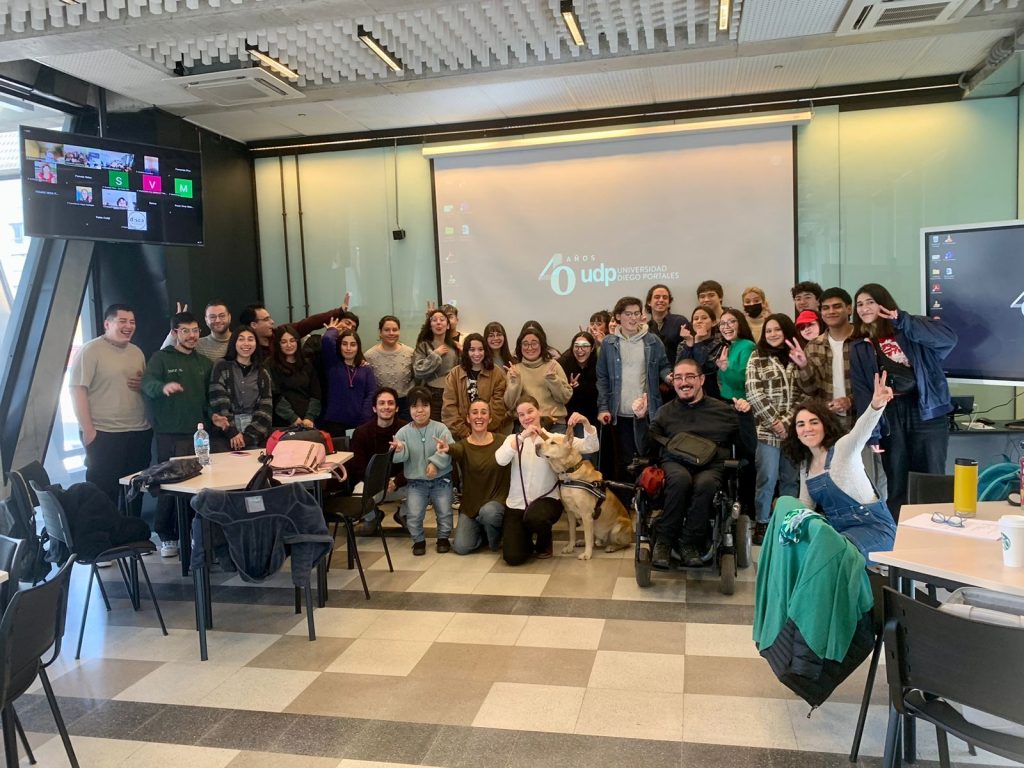
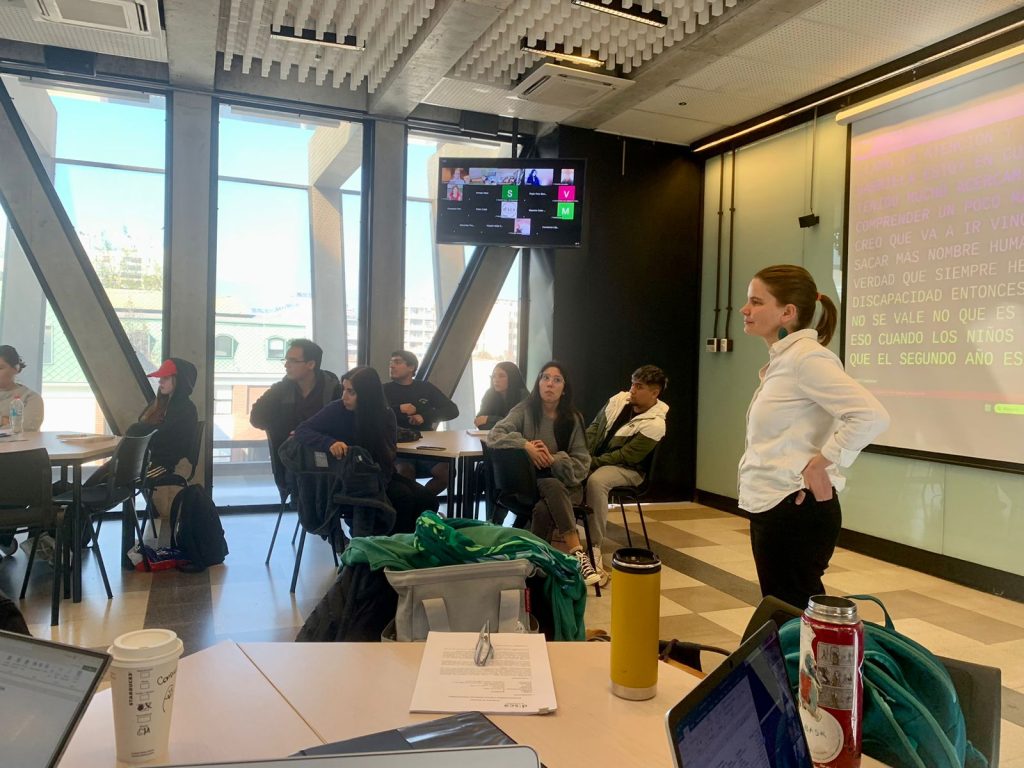
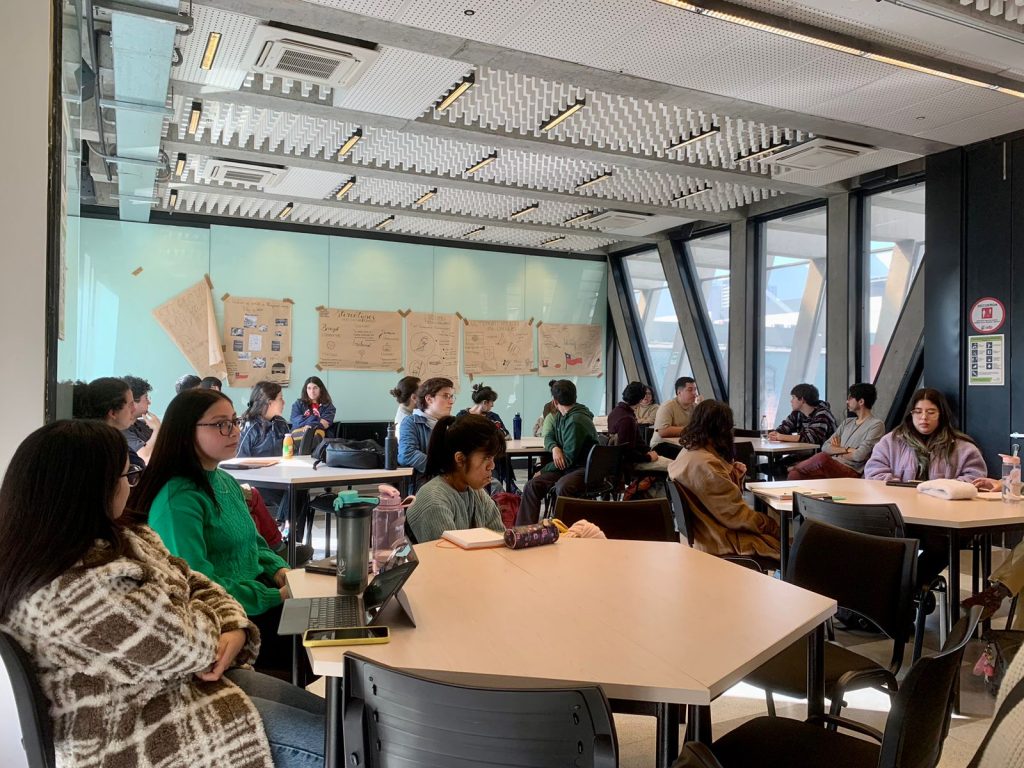
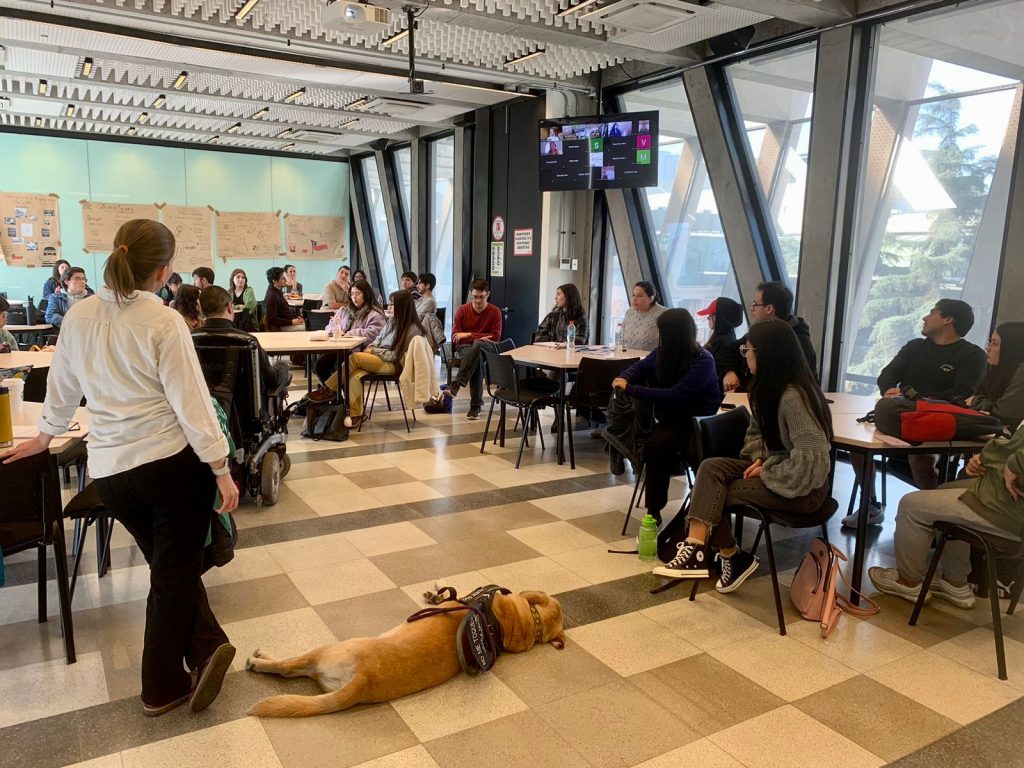
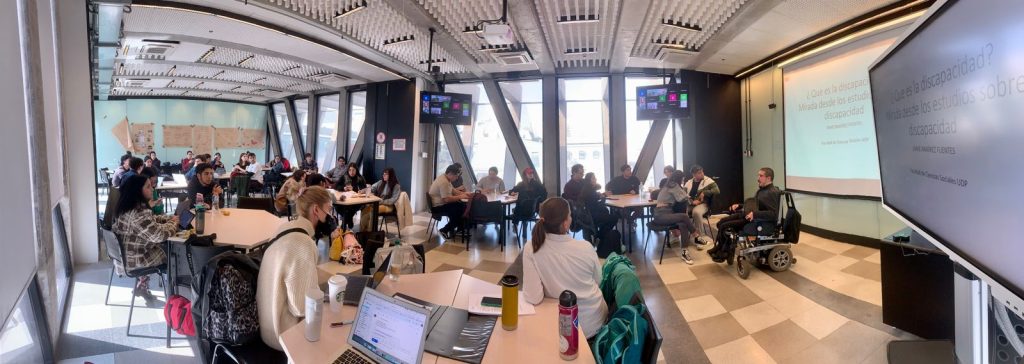
This Tuesday, August 8, we started the first undergraduate course that the Disca Millennium Nucleus together with the School of Sociology UDP is carrying out at the capital city of the Diego Portales University.
The course called “Introduction to Disability Studies” is led by the Director of the DISCA Millennium Nucleus, Florencia Herrera, along with a wide range of researchers and experts from the experience of the Nucleus.
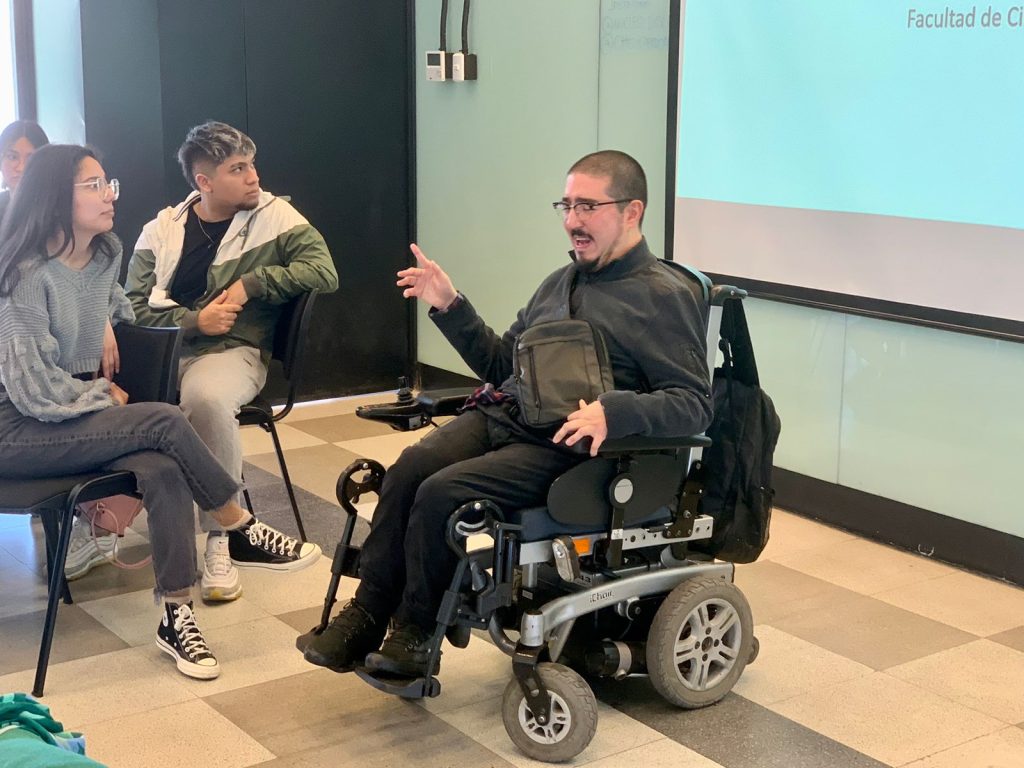
In this opportunity we were accompanied by researcher Jaime Ramirez with a presentation on “What do we talk about when we talk about disability”. We had the attendance of 65 people, of which 35 were students and 30 were external listeners. Likewise, we recognized more than 30 people with disabilities -both in the classroom and telematic modality- which is why we are very happy for the wide reception and interest that this course has awakened in the community.
Comments Off on Salvajes, indígenas, cojas, inválidas: Epistemologías anticapacitistas del Sur [Wild, indigenous, limp, invalid: Anticapacitic epistemologies of the South]
Points of interest:
The article presents an epistemological approach that reflects on corporeality.
The article’s proposal is part of Latin American critical thought.
The aim is to understand the different bodies located in the Global South.
The importance of the sex, gender, and ability system in social and epistemological organization is reiterated.
Notes:
The following summary was prepared by the Millennium Nucleus DISCA and is based exclusively on the publication. Therefore, it cannot be used for citations or references.